AI models come and go. Knowledge should remain.
AI is changing how we design and build software. We can discuss architecture with ChatGPT, generate code with Claude, analyze requirements with Gemini, and explore ideas with dozens of other tools.
But there is a fundamental problem.
Where does all the knowledge go?
After weeks of conversations with an AI, we may have developed an entire architecture, explored alternatives, resolved contradictions, and made hundreds of design decisions.
Much of that knowledge remains buried in chat histories, proprietary memory systems, scattered documents, and disconnected applications.
Switch to another AI model, and you may have to explain everything again.
Even worse, the knowledge is difficult for humans to review, verify, and maintain.
Meet Atlas
Atlas is a proposed open-source system for storing, organizing, and evolving engineering knowledge independently of AI models and vendors.
Think of it as a library of engineering knowledge — something between GitHub, Wikipedia, and an AI-powered software architect.
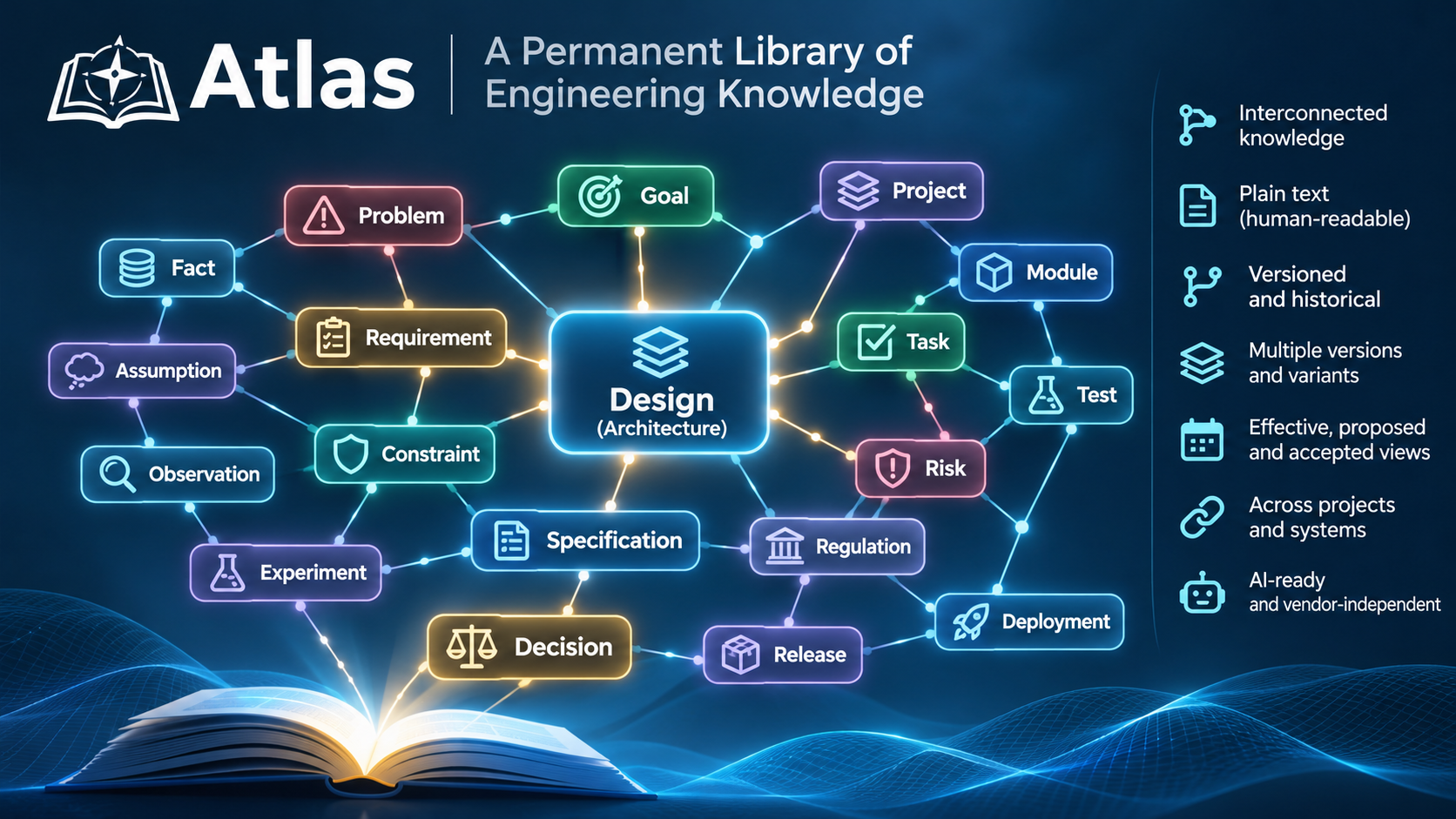
Instead of storing knowledge primarily as conversations, Atlas represents it as a network of interconnected nodes:
Problems, goals, facts, and assumptions
Requirements, constraints, and regulations
Designs, specifications, and architectural decisions
Questions, hypotheses, experiments, and findings
Tasks, tests, releases, and deployments
Each node has a stable identity, attributes, relationships, and history.
And everything is stored in compact, human-readable plain text, version-controlled by Git.
For example:
#id problem/configuration-fragmentation
#type problem
#status Accepted
#motivates goal/unified-configuration
#affects project/config-service
---
Configuration is scattered across applications, making maintenance and deployment difficult.
No proprietary database is required to preserve the knowledge. Humans can read it, Git can track it, and AI can process it.
More Than Documentation
Source code explains how a system works, but rarely captures the complete reasoning behind its design.
Why did we choose this architecture? What alternatives were rejected? Which assumptions were made? Which regulations influenced the decision?
Atlas preserves this knowledge beyond the codebase.
It also understands that designs evolve.
Version 1.0 of a module may remain in production while versions 2.0 and 3.0 are under development. Atlas can preserve their designs simultaneously, including shared foundations, differences, proposed changes, and historical decisions.
A Knowledge Browser could present the effective design for any version, navigate relationships, and reveal the history behind each decision.
One Knowledge System, Many Tools
Today, engineering information is scattered across Jira, Confluence, GitHub, Planner, Octopus Deploy, wikis, and other specialized systems.
Atlas aims to connect them through a common knowledge model.
Specialized agents could synchronize tasks, requirements, documents, code changes, and deployment records in one or both directions.
Atlas could support Agile, Waterfall, research, and hybrid projects without imposing a single methodology.
AI That Doesn't Need to Start Over
Imagine opening a new conversation with any supported AI model and saying:
"Atlas, load my project."
Atlas reads the repository, reconstructs the effective knowledge graph, and understands the current architecture, requirements, decisions, and outstanding problems.
Then you can ask:
"Architect, why did we choose this design?"
"Atlas, process the new Inbox notes."
"Atlas, what will be affected if we change this interface?"
"Atlas, compare the accepted design with the proposed version."
No special handoff document. No need to replay months of conversations.
The repository is the memory. The AI is the reasoning engine.
Building a Library for the AI Age
Books preserve human knowledge across generations. Wikipedia connects facts into a shared encyclopedia. Git preserves the evolution of software.
Atlas brings these ideas together for engineering.
The goal is not to build yet another AI chatbot or project management application.
It is to create a permanent, open, versioned library of design knowledge — including ideas, alternatives, discussions, decisions, and their relationships.
A library that people can inspect, developers can maintain, and different AI models can use.
AI models will come and go. Our knowledge should remain.
We've written a detailed introduction to Atlas, an open-source, AI-independent knowledge management framework covering persistent engineering knowledge, interconnected nodes, plain-text storage, Git history, design versioning, effective and proposed views, cross-project relationships, and AI-powered agents.
Read the full article: Atlas — Permanent Library of Engineering Knowledge
Atlas is a proposed open-source architecture for preserving and evolving engineering knowledge independently of AI models, vendors, and proprietary platforms.
#Atlas #KnowledgeManagement #ArtificialIntelligence #SoftwareArchitecture #OpenSource #KnowledgeGraph