Can complex behavior emerge from the interaction of a few simple geometric structures?
Financial markets appear chaotic. Millions of participants, algorithms, and institutions continuously interact, producing a price trajectory that seems unpredictable.
But what if there is another way to describe that complexity?
Over months of studying QQQ price movements, we've been developing a framework based on fixed geometric lattices.
We identified several recurring structures:
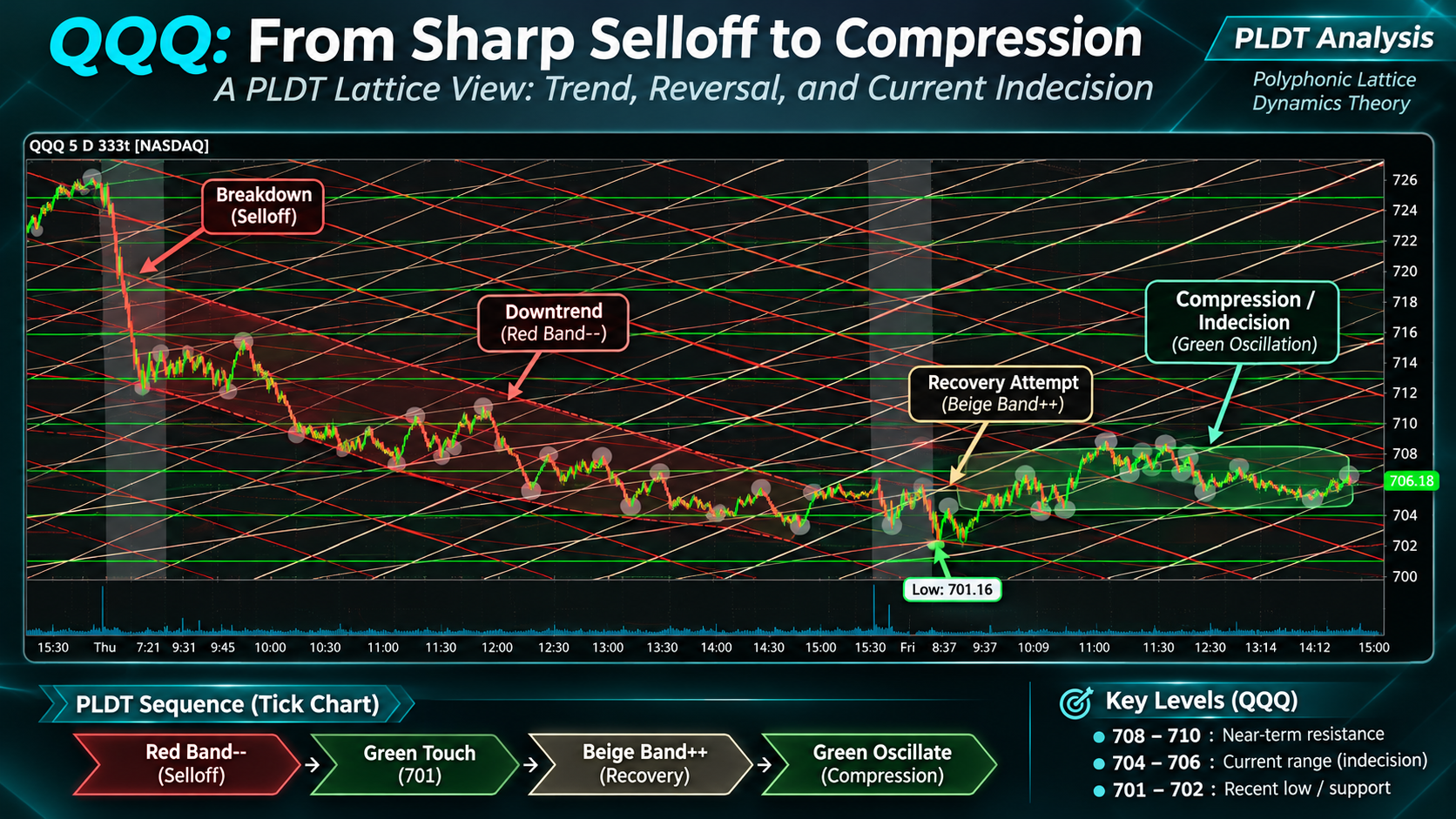
Red: Slow and fast descending channels.
Beige: Slow and fast ascending channels.
Green: Horizontal price levels.
Each structure behaves like an independent musical voice, with its own boundaries, oscillations, and transitions.
Price can oscillate within one lattice while simultaneously tracking a boundary of another. Sometimes the voices reinforce each other. Sometimes they compete. At intersections, the behavior may change.
We call this approach Polyphonic Lattice Dynamics Theory (PLDT).
Its central hypothesis is:
Complex behavior emerges from the interaction of multiple simple, quantized dynamical structures.
Its first application, Market PLDT (M-PLDT), introduces a compact language for market behavior:
Touch → Oscillate → Grind → BandShift → ControllerSwitch
It also introduces the Polyphonic Sheet: a musical-score-like representation with a separate lane for each geometric voice.
Our latest QQQ charts from October 23, 2026, illustrate the idea. The hourly chart shows a relatively simple larger-scale structure, while the tick chart reveals the complicated interactions occurring within it.
The next step is to test whether this geometric language offers genuine predictive value, rather than merely describing historical patterns.
What makes this research particularly interesting is its history. The geometric lattices were created months ago and never needed to be adjusted to fit subsequent prices. We have accumulated more than 100 successive daily chart screenshots and a chronological record of predictions made using these structures. In October 2026, during a period of major economic announcements and unusual market behavior, we encountered an exceptional case: the tick-level lattice appeared to require a half-channel phase shift, while the hourly structure remained intact. Subsequent observations have continued to show correspondence with the shifted tick lattice. This gives us a concrete, testable hypothesis about geometric stability and discrete phase transitions.
We've written a detailed introduction covering the mathematical model, quantization, preferred states, intersections, phase transitions, multiple timeframes, and the research program.
Read the full article: Polyphonic Lattice Dynamics Theory — A Framework for Understanding Complex Systems
PLDT is a proposed research framework, not an established theory of market behavior.
#PLDT #MarketDynamics #ComplexSystems #QuantitativeFinance #Research